


Prior authorization is an important checkpoint in the healthcare revenue cycle, but getting an approval does not always mean the claim will be paid. A procedure, treatment, diagnostic service and/or medical item may be approved by a payer prior to receipt, and the final claim may be submitted against other billing/coding/documentation/coverage requirements.
This poses a common revenue cycle challenge for providers. It could be an approved service but the billed service may not be the same as the approved service, the provider may be billing for more units than they are authorized, the approval may be ending, or the information needed to approve the service may not be received by the claim. These problems lead to payment delays, rejection of payments, extra follow-up and unnecessary administrative expenses.
The process is also changing. Starting on January 1, 2027, there are specific CMS-d regulated payers who are required to implement electronic prior authorization and interoperability APIs. Medical billing providers should thus not only plan to ensure improved authorizations processes, but also how they will be integrated with their EHR system, billing system and payment posting.

Reduce claim denials with reliable prior authorization support.
What Is Prior Authorization in Medical Billing?
Prior Authorization in Medical Billing is a payer review that takes place before certain healthcare services are provided. Authorizations might be needed for procedures, advanced imaging, specialty treatments, durable medical equipment or other covered services that are subject to utilization management, depending upon the health plan.
Typically, the provider would provide a diagnosis, a request for service, clinical documentation, and procedure information. Authorized services, units, visits and effective dates will be provided by the payer if authorized. Those pieces of information should then be accessible to the scheduling, clinical, coding, and billing teams.
What’s key is that authorization is just the beginning. The provider may require special approval to submit the claim if the treatment differs from the approved treatment or the service is rendered outside of the approved conditions.
Why Can an Approved Claim Still Have a Payment Problem?
Approval for prior authorization does not ensure payment. The claim must still accurately reflect the service that was authorized and satisfy other requirements that may apply to the claim by the payer.
A procedure for instance, may be ordered by a payer but then billed by the provider for two units. The billed CPT or HCPCS code can also be different from the approved service or the procedure can be performed after the authorization has passed. In this instance, the original approval might be correct, but the claim submitted is not the claim paid by the approver.
Providers must therefore think of authorization as a revenue cycle event and not just a chore. Authorization information must be current during scheduling, service delivery, coding, claim submission, claims posting and claims denial follow up.
What Should Providers Verify Before Billing?
Billing teams should compare the claim with the authorization record prior to releasing the claim. They must at least ensure the approved service or appropriate CPT/HCPCS code, units/visits, effective date(s), provider or location, and payer required reference such as authorization number.
This check is especially useful if a patient’s treatment changes. For those who may perform another procedure or modify the intended service, staff should check with the physician to see if an additional authorization is needed from the payer, or if the payer will allow the procedure or change.
Utilization of authorizations also should be monitored. If, for instance, a practice has received approval for 8 therapy visits, it should know how many visits it has used and when it will need to be approved for more. This can block the practice from the offering of services exceeding the approved scope and finding out about the problem at the time of claim denial.
Why Documentation Still Matters After Approval?
Authorization does not replace the need for proper clinical documentation. The medical record should sustain the services provided and the claim should accurately depict the service. Supports may consist of physician orders, clinical notes, diagnostic results, or treatment plans depending on the payer and the service.
This is particularly important if there is a payer review of a claim after authorization. An authorization number does not automatically mean that all the payment requirements for the billed service were satisfied. Having a clear link between authorization, clinical record, service provided and the claim puts the provider in a better position for payment review or appeal.
What Is Payment Posting in Medical Billing?
What does payment posting mean in medical billing? It involves capturing claims-level payments, contractual adjustments, patient responsibility, denials, and any other financial data of the claim in the provider’s billing system.
Payment posting is more than just recording the amount received from an insurance company. The electronic remittance advice (ERA) or explanation of benefits (EOB) may include information about the adjudication of the claim and why a payment amount was paid, reduced, or denied.
CMS uses Claim Adjustment Reason Codes (CARCs) and Remittance Advice Remark Codes (RARCs) to convey claim adjustment information. When reviewing this information, providers can determine if an unexpected payment is for authorization, coding, coverage, documentation or some other billing problem.
Payment Posting in Medical Billing Flow Chart
A practical payment posting in medical billing flow chart for authorization-related claims is:
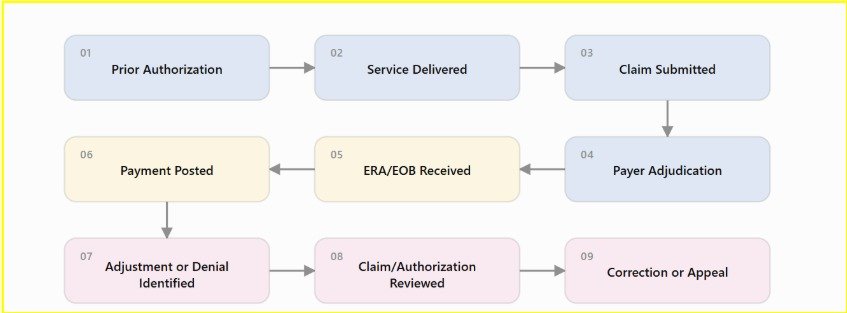
Keeping the authorization record accessible at the payment stage is important. If a claim does not pay as expected, the billing team can compare the remittance with the original authorization and determine where the mismatch occurred.
How the Payment Posting Process Can Improve RCM?
In medical billing, the payment posting process can expose issues that can’t be detected if staff members just know whether an authorization was approved or denied.
Assume that the same procedures are continually being adjusted in a single practice. A review of the remittance data may show that the same CPT code is being submitted with units of service greater than approved, authorization numbers are entered incorrectly or claims are submitted after the authorization has expired. Rather than fixing individual claims, the provider can go to the workflow that is the root cause of the problem and modify that workflow.
This means that payment posting is invaluable for the revenue cycle. Denial trends can help authorization teams verify better and help billing managers pinpoint payer-specific issues and determine if process changes are actually helping to decrease payment issues.
What Is Changing for Providers in 2027?
The largest development thrust that providers who service the largest number of patients in the CMS system should be expecting is the shift to electronic prior authorization. Starting January 1, 2027, certain affected Medicare Advantage organizations, Medicaid and CHIP programs and managed care plans, as well as qualified Health Plan issuers in federally-facilitated exchanges, will have to implement applicable interoperability and prior authorization APIs.
The Prior Authorization API is intended to enable e-flows for authorization determination, documentation determination, submission and decision. CMS will also mandate that certain prior authorization information be accessible electronically via the Patient Access API, and that Provider Access and Payer-to-Payer APIs be available for transmitting certain health information electronically.
The real challenge for providers is system readiness. CMS advises providers to understand how their EHR vendors will integrate with HHS before 2027, the timeline of implementation, testing, training, and if any upgrade of the EHR or a new module will be necessary.

Prepare for 2027 CMS changes with expert RCM support.
What Providers Should Do Before January 2027
Providers should begin by determining which payers and which services will be impacted in their organization. Not all commercial payers have the same requirements for CMS and the practice shouldn’t assume they will all use the same electronic process.
Then a technology readiness should be reviewed. Inquire if the EHR or practice-management vendor can support electronic prior authorization workflows, how authorization will be documented in the system, and if authorization data can be passed on to downstream billing without having to re-enter it manually.
Training for staff is also crucial. It is important that teams are aware of the process for making a request, tracking decisions, responding to requests for further information and applying authorization data when submitting for billing if an electronic workflow is to be used to reduce the administrative workload. CMS strongly urges vendors of EHRs and staff to be ready for the 2027 deadline.
2026 Requirements Providers Should Already Be Using
Enhanced requirements are in place for some of the affected payers, and the 2027 changes are based on these requirements. Applicable payers will be required to respond to requests for prior authorization determinations within 72 hours of the request for covered medical items and services (excluding drugs) for expedited requests and within seven calendar days of the request for covered medical items and services (excluding drugs) for regular requests, beginning January 1, 2026. Additionally, payers with impacted authorizations must give a particular reason for their denial.
These requirements can be used by providers to boost internal follow-up. Submission dates, requests for additional information, payer decisions and reasons for denial should be recorded to allow staff to escalate delayed cases and to identify if a denied request can be corrected or appealed.
DMEPOS Providers Have Additional 2027 Changes
Suppliers need to be mindful of CMS’s updated Required Prior Authorization List for DMEPOS supplies. In 2026 additional selections were announced by CMS, such as a manual wheelchair base, a pressure-reducing support surface, and some types of orthoses. Two upper-limb orthosis codes have been rolled out with a phased implementation, starting from January 26, 2027 for the second phase and April 26, 2027 for the nationwide implementation.
Suppliers should use the current CMS list, and cross check applicable HCPCS codes, not internal references, because prior authorization may be a requirement for payment of applicable DMEPOS items.
What About the Proposed 2027 Drug Changes?
Providers should identify completed requirements from proposals. CMS has published a proposed rule for 2026 with more electronic prior authorization and decision timeframe proposals for some drugs, some of which have proposed compliance dates starting on October 1, 2027. These provisions are proposed, but not final, requirements and not a mandate to present until finalized by CMS.
For the time being, providers should pay attention to the finalized CMS-0057-F requirements and wait for additional updates from CMS to see if there are any changes to the drug prior authorization process.
When Outsourcing Prior Authorization Makes Sense
Outsourcing may offer extra operational assistance for practices with high authorization volumes or a variety of payers. The RCM team can help with authorization verification, documentation gathering, payer follow up, authorization tracking, claim review, and denial research are some of the many services that a team of experienced RCM professionals can provide.
The best outsourcing model is not to consider authorization a service by itself, but to tie these activities together. Providers should seek quantifiable measures like authorization turnaround time, authorization-related denial rates, claim accuracy, follow-up time and recovered revenue. Medical billing can also identify recurring payer and workflow problems when there is a connection between authorization work and posting of payments.
Conclusion
Reducing uncertainty before the service is provided through prior authorization can help lower the risk of uncertainty, but prior authorization is no guarantee of payment. It is the responsibility of the provider to ensure that the authorization, service, documentation, coding and claim is consistent across the revenue cycle.
This is even more critical as of 2027 CMS changes. Providers should be ready to implement the electronic prior authorization APIs with their technology, staff and workflows, sooner rather than later as more payers are transitioning to the electronic prior authorization process. Meanwhile, payment and denial information should be analyzed to detect authorization issues that may be impacting reimbursements.
Frequently Asked Questions
1. Does prior authorization guarantee claim payment?
No. Authorization does not mean approval for a requested service with certain conditions, other coverage, coding, documentation and payer requirements apply to the final claim.
2. What should providers check after receiving authorization?
Providers are required to confirm the approved service, CPT or HCPCS code (if applicable), number of units or visits, effective dates, provider or location data and authorization number prior to billing the service.
3. What changes for prior authorization in 2027?
Some CMS-regulated payers will have to adopt applicable Prior Authorization and interoperability APIs on January 1, 2027. These APIs have been created to enable a more electronic and standardized authorization process.
4. How does payment posting help identify authorization problems?
The payment posting process in medical billing allows teams to review payer adjustments and denial information. A comparison of those results to the original authorization can aid in determining any mismatched services, units, dates, or authorization information.
5. What should providers do now for 2027?
Providers need to determine which payers are impacted, contact their EHR or practice-management software vendors, evaluate their electronic prior authorization options, schedule staff training, and set up workflow for utilizing prior authorization information in billing/payment reconciliation.
